

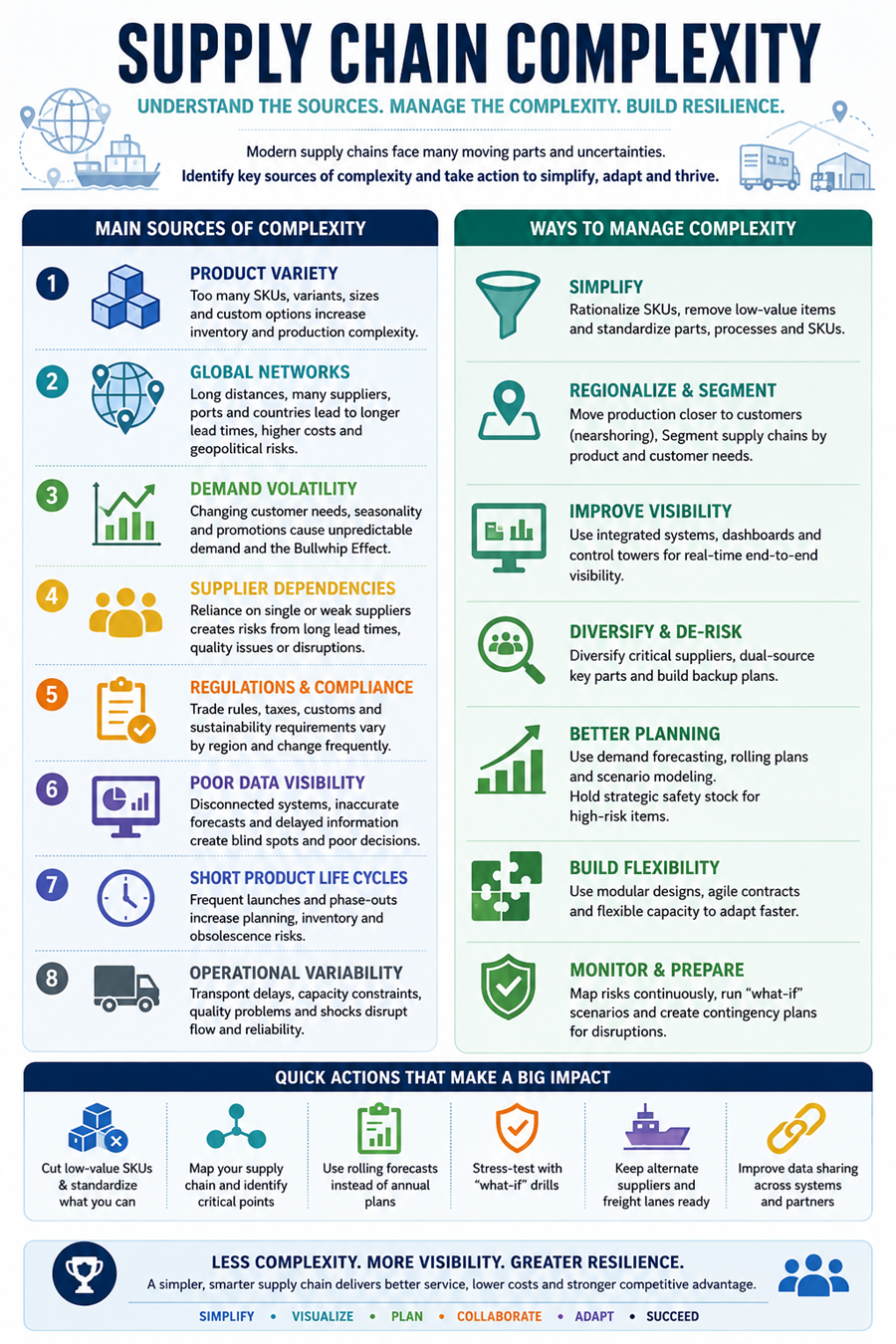
Managing a modern supply chain requires balancing numerous internal and external factors that contribute to operational difficulty. According to the sources, the primary drivers of complexity include product proliferation, where offering too many variants or SKUs increases inventory hurdles and production strain. Global sourcing further complicates operations by introducing long lead times, geopolitical risks, and currency fluctuations across distant networks. Demand volatility and unpredictable customer behavior often lead to the “Bullwhip Effect,” which amplifies demand swings throughout the chain. Additionally, fragmented data and disconnected software systems create significant visibility gaps, making it difficult for departments to align. Other contributing factors include a heavy dependency on single suppliers, complex international regulations, and external shocks such as pandemics or extreme weather.
To effectively manage and mitigate these complexities, several strategic actions are recommended:
- SKU Rationalization: Companies should simplify their product range by removing low-performing items to focus on high-value products.
- Regionalization and Nearshoring: Moving production closer to the end customer can significantly reduce lead times and exposure to global transport delays.
- Integrated Planning and Visibility: Implementing shared digital dashboards, such as “Control Towers,” provides real-time tracking and ensures all partners are viewing the same data.
- Standardization: Streamlining parts, processes, and supplier requirements helps reduce operational variability.
- Supplier Diversification: Avoiding single-point failures by dual-sourcing key components and building closer relationships with critical partners enhances resilience.
- Buffer Management: Holding strategic safety stock for high-risk items and mapping potential risks through “what-if” drills allows for better contingency planning during disruptions.
- Advanced Forecasting: Utilizing better data and rolling forecasts rather than static annual plans helps the supply chain adapt to changing customer needs.
By focusing on simplification and transparency, organizations can build more agile and resilient supply chains capable of navigating today’s complex global market.

Danish Mairaj is a medical device expert with a strong focus on regulatory and quality compliance. He has been involved in managing clinical trial infrastructure including supplies and logistics. He has over 15 years of experience in the MedTech and Pharmaceutical industry. He is a certified Product Owner, Scrum Master, and Project Management Professional PMP. He studied Biomedical Engineering in Germany and MedTech Regulatory & Quality in Galway, Ireland. He contributes articles to the BRASI newsletter.
- Danish Mairaj#molongui-disabled-link

- Danish Mairaj#molongui-disabled-link

- Danish Mairaj#molongui-disabled-link

- Danish Mairaj#molongui-disabled-link